- English
- French
- German
- Portuguese
- Spanish
- Russian
- Japanese
- Korean
- Arabic
- Irish
- Greek
- Turkish
- Italian
- Danish
- Romanian
- Indonesian
- Czech
- Afrikaans
- Swedish
- Polish
- Basque
- Catalan
- Esperanto
- Hindi
- Lao
- Albanian
- Amharic
- Armenian
- Azerbaijani
- Belarusian
- Bengali
- Bosnian
- Bulgarian
- Cebuano
- Chichewa
- Corsican
- Croatian
- Dutch
- Estonian
- Filipino
- Finnish
- Frisian
- Galician
- Georgian
- Gujarati
- Haitian
- Hausa
- Hawaiian
- Hebrew
- Hmong
- Hungarian
- Icelandic
- Igbo
- Javanese
- Kannada
- Kazakh
- Khmer
- Kurdish
- Kyrgyz
- Latin
- Latvian
- Lithuanian
- Luxembou..
- Macedonian
- Malagasy
- Malay
- Malayalam
- Maltese
- Maori
- Marathi
- Mongolian
- Burmese
- Nepali
- Norwegian
- Pashto
- Persian
- Punjabi
- Serbian
- Sesotho
- Sinhala
- Slovak
- Slovenian
- Somali
- Samoan
- Scots Gaelic
- Shona
- Sindhi
- Sundanese
- Swahili
- Tajik
- Tamil
- Telugu
- Thai
- Ukrainian
- Urdu
- Uzbek
- Vietnamese
- Welsh
- Xhosa
- Yiddish
- Yoruba
- Zulu
Soy Amino Peptide
Main Active: Soy protein
Purity: 95%+
Made in: P.R. China
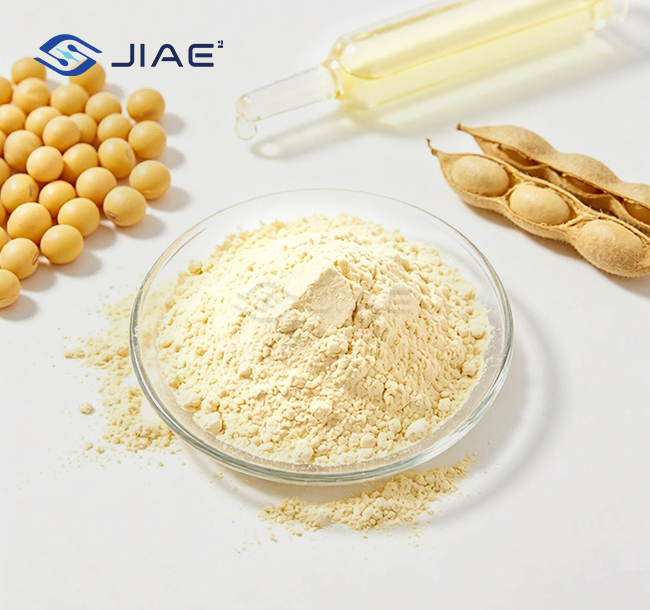
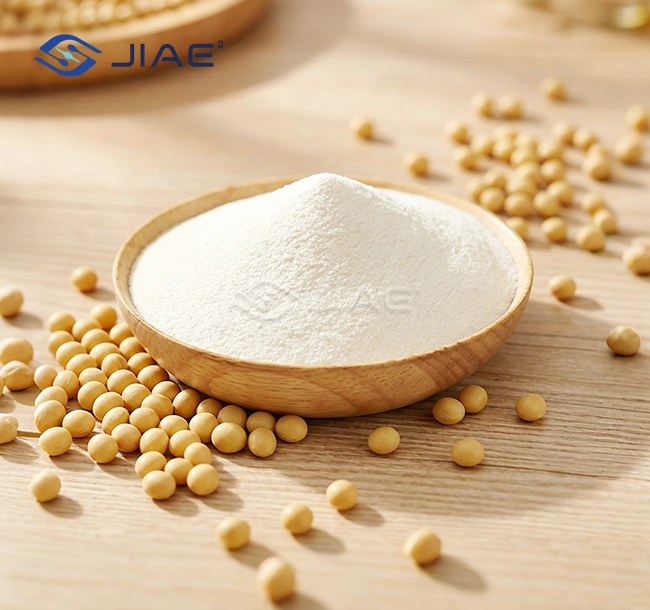
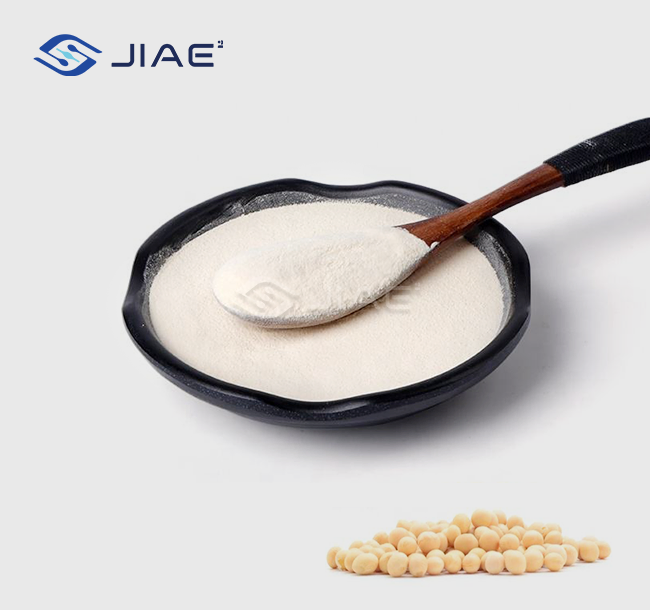
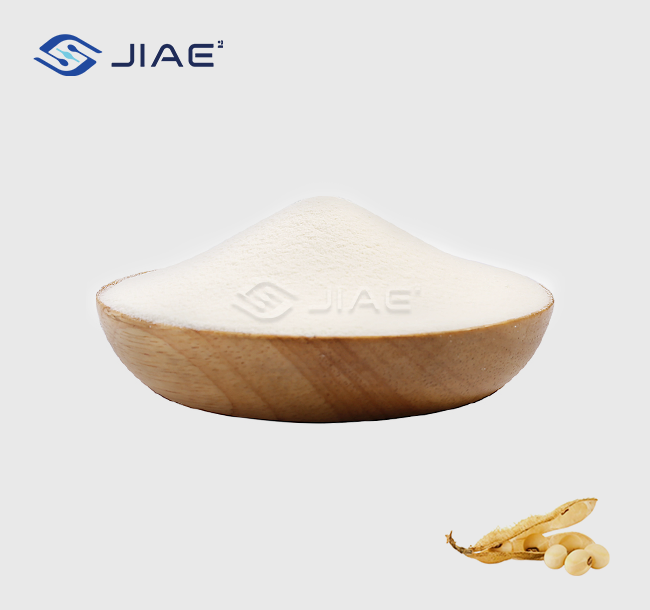
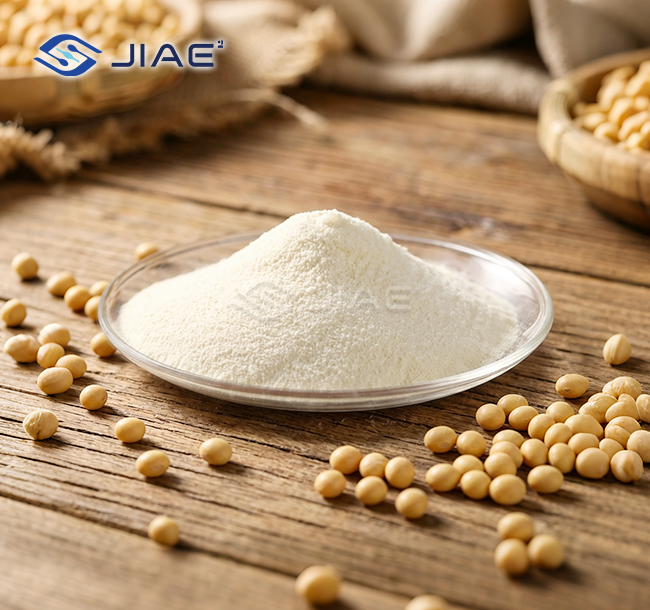
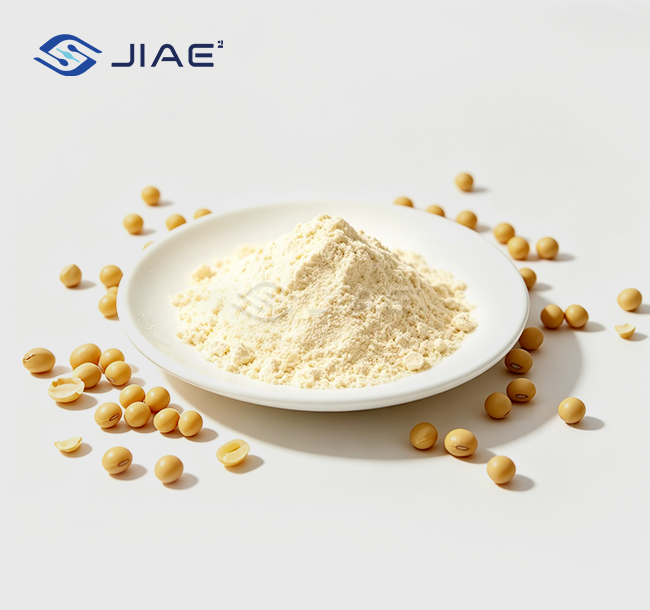
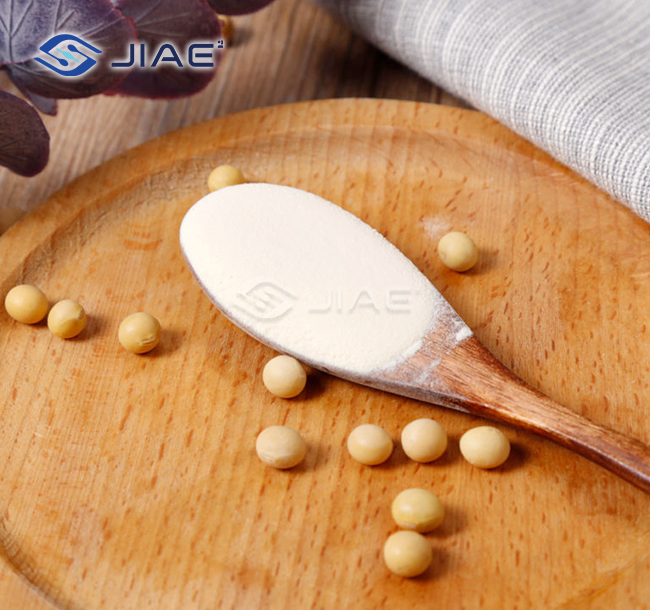
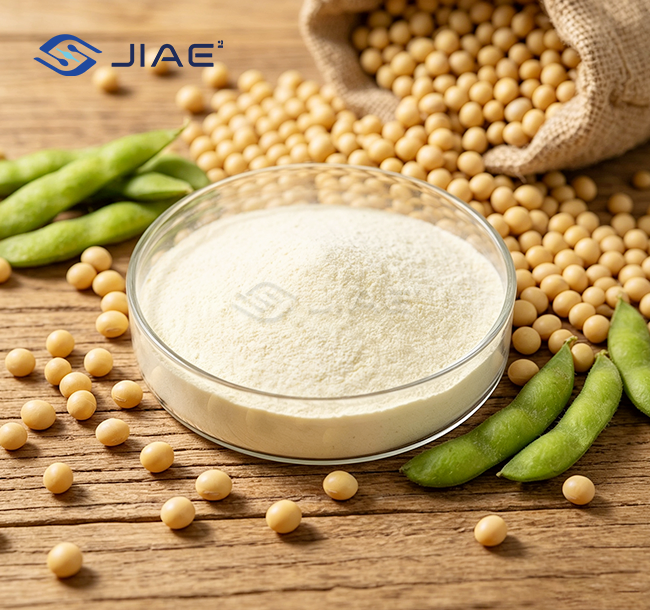
Physical Form: White to light yellow powder
Certified: FDA、 ISO9001、 ISO22000、 HACCP、 BRC、 FSSC22000、HALAL
Trade Incoterms: EXW, FOB, CFR, CIF, DAP, DDP
Payment Options: T/T Wire Transfer Preferred
Transportation: Air/Sea/Rail
Available Services: OEM / ODM
Supply: Ample Stock; Secure & Prompt Delivery
Package Options: 10 kg, 20 kg
Min. Order Qty: 20 kg
Shelf Life: 2 years
CAS ID: 68308-82-7
High-Purity Soy Amino Peptide | Plant-Based Bioactive Protein for Improve Absorption & Functional Nutrition
Jia Yi Bio turns out food-grade Soy Amino Peptide at 95%+ purity. The raw material is non-GMO soy isolate. A new enzymatic hydrolysis step breaks that isolate down. Supply stays large and steady. Behind the product sit 23 years of bioactive peptide manufacturing, plus 15,000 tonnes of output a year spread over many production bases. Four certifications back it up: FDA, HALAL, BRC, and FSSC 22000. Molecular weight stays low (<1,000 Daltons). Acidic conditions do not stop the peptide from dissolving. Sports nutrition is one fit. Clinical enteral formulas are another. Clear liquids work too. Typical soy proteins fail in all of those spots.
What Makes Our peptide Strong for Industrial Applications?
This product pushes plant-based protein technology forward. The bioactive short-chain peptides (2-6 amino acids) do not dissolve the way proteins do. PepT1 transporters in the intestine take them straight in. Clinical trials show they deliver nitrogen faster than regular whey isolates.
Our manufacturing process takes on four big concerns in the industry. Targeted enzymes break the Gly m 5 and Gly m 6 proteins down, and soy allergenicity drops as a result. The product also stays clear in acidic conditions. Typical isolates precipitate there instead. Hydrolysis neutralizes antinutrients and trypsin inhibitors as well.
A functional powder comes out of our plant. Drop it into water at 20% concentration and it dissolves at once, with no turbidity in the solution. UHT processing leaves the powder stable. Because of that, aseptic filling lines handle it without trouble. Shelf life runs to 24 months under conventional storage. Moisture has to stay below 7%.
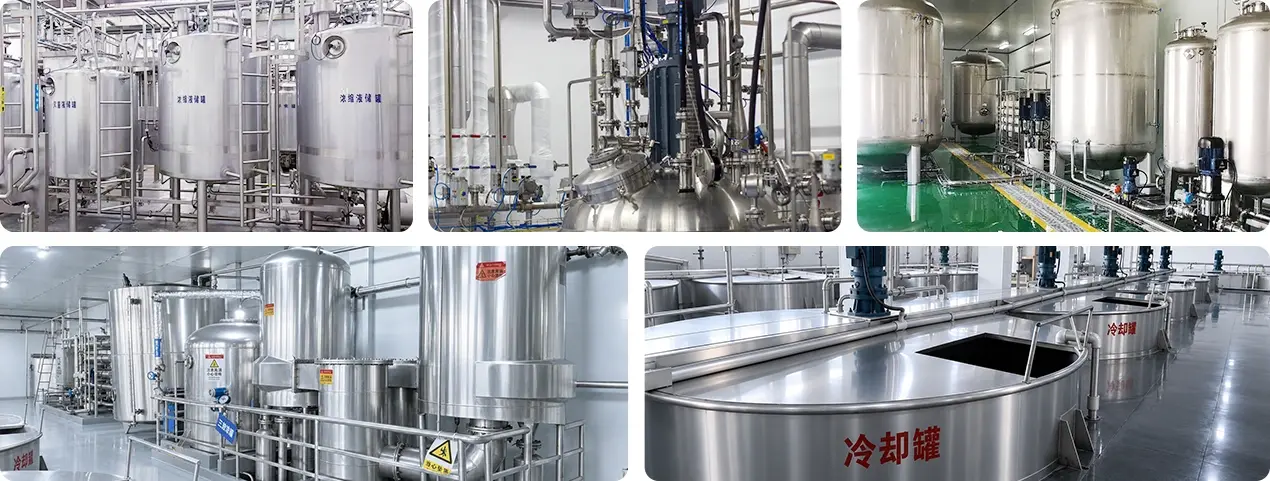
Technical Specifications & Quality Parameters
| Testing Content | Test Method | Testing Value | Single Conclusion | Testing Method | ||
| Sensory Requirements | White or light yellow, with the taste and smell of the product, no odor, powdery or detailed, no clumps, no foreign bodies visible in normal vision. |
Conformed | Qualified | GB 31611 | ||
| Moisture/(g/100g) | ≤7.0 | 4.1 | Qualified | GB 5009.3 | ||
| Ash/(g/100g) | ≤7.0 | 5.7 | Qualified | GB 5009.4 | ||
| Total Nitrogen/(g/100g) | ≥11.2 | 14.8 | Qualified | GB 5009.5 | ||
| Crude protein / (dry basis, N*6.25, g/100g) |
≥70.0 | 92.5 | Qualified | GB 5009.5 | ||
| Relative percentage of peptides with relative molecular masses in the range of 189-10,000 / % |
≥60.0 | Conformed | Qualified | GB 31645 | ||
| Urease (urease) activity | Negative | Conformed | Qualified | GB 20371 | ||
| Crude fat (dry basis) / % | ≤1.0 | Conformed | Qualified | GB 5009.6 | ||
| pH | / | 6.33 | Qualified | / | ||
| Stacking Density/(g/ml) | / | 0.46 | Qualified | / | ||
| Arsenic/(mg/kg) | ≤0.3 | Conformed | Qualified | GB 5009.11 | ||
| Cadmium/(mg/kg) | ≤0.1 | Conformed | Qualified | GB 5009.15 | ||
| Lead/(mg/kg) | ≤0.8 | Conformed | Qualified | GB 5009.12 | ||
| Total Mercury/(mg/kg) | ≤0.1 | Conformed | Qualified | GB 5009.17 | ||
| Total Bacteria/ CFU/g | n=5,c=2,m=10³,M=10⁴ | 110,40,20,90,120 | Qualified | GB 4789.2 | ||
| Coliforms/ CFU/g | n=5,c=2,m=10,M=10² | <10 | Qualified | GB 4789.3 | ||
| E.coli / CFU/g | ≤10.0 | Conformed | Qualified | GB 4789.38 | ||
| Mould/ CFU/g | ≤50.0 | <10 | Qualified | GB 4789.15 | ||
| Salmonella species / CFU/g | n=5,c=0,M=0 | Conformed | Qualified | GB 4789.4 | ||
| Staphylococcus aureus/ CFU/g | n=5,c=0,M=10² | Conformed | Qualified | GB 4789.10 | ||
Why Choose Jia Yi Bio as Your Peptide Partner?
Bioactive peptides sit at the centre of our R&D work. We have 23 years behind us. Buyers count on us as a supplier they can stay with. Backup capacity sits in Hunan, Zhejiang, Jiangxi and Gansu. Sites abroad add more on top. A regional interruption then poses less risk to your supply chain.
Overseas warehousing gives you an edge. North American customers get a 10-day turnaround from our site in Chino, California. Container shipments get combined. That step helps us dodge ocean freight delays. Landing costs drop too.
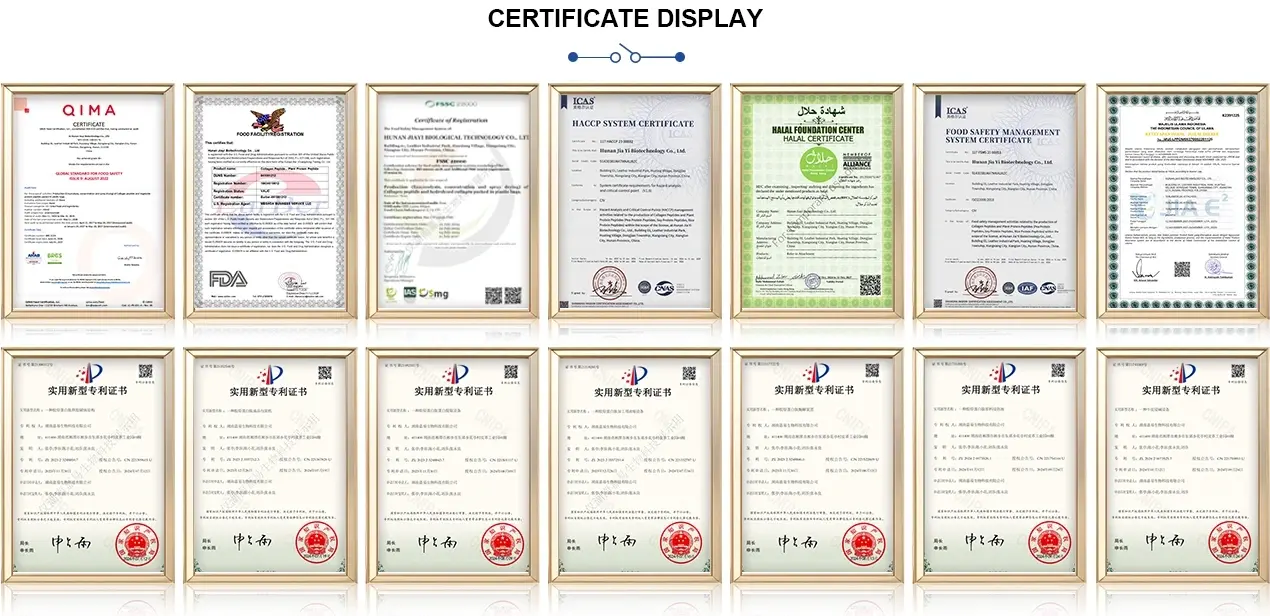
Sites around the world are covered by our certifications. ISO 9001 and ISO 22000 sit in that set. HACCP and HALAL are included as well. Every batch leaves with a full COA. An MSDS comes with it. Third-party test reports also ship. Our traceability records reach back three years. Before any batch ships, it gets checked twice. The quality rules we follow at home are tighter than national standards.
Payment terms that give you room help cash flow. Approved clients can pay by L/C or T/T. Those terms run 30 to 60 days. Full customs clearance stays with us. Because of that, we deliver Soy Amino Peptide turnkey under EXW to DDP terms.
Customization for Your Distinct Formulation Needs
Your spec sets the product we build. Longer chains let go slowly. Shorter ones work faster. To match your use, we tune molecular weight distribution. Solubility can change. Bulk density can as well. Turbidity is one more property that moves. A pill can act one way. A liquid is a different case. Gummy and RTD forms each hold their own profile.
Debittering and deodorisation tune the taste. Enzymes handle the job, so bitterness goes down. No other peptides in the industry taste as pure as ours.
For a trial, the smallest sample is 1 kg. Industrial boxes go as high as 20 kg. Bags are made of food-grade aluminium foil. We can vacuum seal them. English labels are one option. Arabic labels can be supplied too. Japanese and Spanish labels are available as well. Outside packing works for Amazon FBA. It also suits bulk delivery on pallets.
Real-World Applications Across Multiple Industries for Soy Amino Peptide
Sports Nutrition: One use is in recovery drinks after a workout. How fast something absorbs changes muscle protein production. Di- and tri-peptides respond to insulin quickly. Glycogen returns faster than it does with full proteins.
Clinical Nutrition: Our peptides get used by hospitals. The makers of enteral feeding products use them as well. People who struggle to digest food are why both of them buy. Add peptides to a meal replacement shake and it goes down more easily. Elderly care residents benefit from that. Plenty of them just don't eat enough.
Our peptides suit clear protein waters. They suit fruit-flavored sports drinks too. Put them in citric acid systems and the drink stays clear. Acidic surroundings don't change that. Soy isolates work another way. They go cloudy at isoelectric pH.
Our peptides go into creams that repair the skin barrier. They also go into serums that fight ageing. Researchers in dermatology studied the small molecules inside Soy Amino Peptide. Other substances pass through the skin with less resistance thanks to those molecules. Fibroblast activity gets support from them too. So does collagen formation.
FAQ
Q: Why does it absorb differently than Soy Protein Isolate?
A: The di-/tri-peptide transport system takes these peptides in. That route is faster. It also beats the amino acid transport system that digested isolates depend on.
Q: Does it work in clear acidic drinks?
A: Yes. An acidic setting makes soy isolates go solid. These peptides don't. They stay clear and fully soluble. That is why they fit fruit-flavored protein drinks.
Q: Is the product hypoallergenic?
A: Raw soy does not act the same way. Key allergens get broken down by the enzymatic process. Gly m 5 and Gly m 6 are two examples. Allergic potential drops at that step.
Q: How does it affect product flavour?
A: Debittering and deodorization are steps in making solid peptides. What comes out has a mild taste. Sometimes it is a bit savory. In functional food products, masking that is not hard.
Q: Shelf-life and storage requirements?
A: Moisture content stays low. Water activity is low too. Store it in a cold, dry place and the product holds up for 24 months in its original unopened packaging.
Contact
To ask for a quote or a sample, send wholesale or export inquiries about Soy Amino Peptide to jiayi@biojiae.com.